
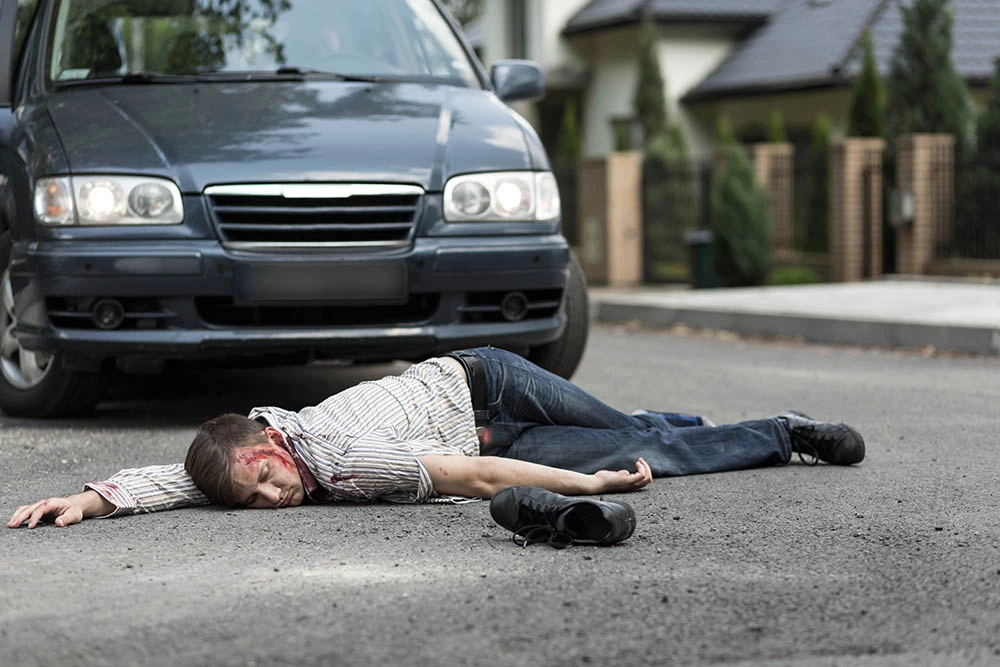
Failure to Stop and Assist
Failing to stop and assist after a vehicle impact in NSW is prosecuted under section 146 of the Road Transport Act 2013 or, where death or grievous bodily harm is caused, section 52AB of the Crimes Act 1900. Maximum penalty up to 10 years imprisonment.
About failing to stop and assist in NSW
“Failing to stop and assist” in NSW covers two overlapping scenarios — and which provision applies depends on whether anyone was hurt and how seriously.
- After a crash involving a vehicle — where the vehicle is in an impact occasioning injury, the driver can be charged under section 146 of the Road Transport Act 2013 (NSW). Where the impact occasions grievous bodily harm or death, the prosecution can elevate the charge to section 52AB of the Crimes Act 1900 (NSW) — a serious indictable offence carrying up to 10 years imprisonment.
- Failing to stop when directed by police — a distinct offence under section 39 of the Law Enforcement (Powers and Responsibilities) Act 2002 (NSW), with a higher-tier “police pursuit” offence (Skye’s Law) under section 51B of the Crimes Act 1900 where the driving is reckless or dangerous.
These are major traffic offences. A conviction under section 146 or section 52AB carries an automatic licence disqualification and, in the more serious cases, full-time imprisonment is a realistic outcome even for first offenders. Strategy needs to be set before the first court mention.
Section 52AB Crimes Act 1900 — failing to stop and assist after vehicle impact causing death or GBH
Section 52AB of the Crimes Act 1900 (NSW) creates the more serious form of the offence. It applies where the impact causes grievous bodily harm (GBH) or death.
A person is guilty of an offence under this section if — (a) a vehicle being driven by the person is involved in an impact occasioning the death of, or grievous bodily harm to, another person, and (b) the person knows, or ought reasonably to know, that the vehicle has been involved in an impact occasioning death or grievous bodily harm to another person, and (c) the person fails to stop and give any assistance that may be necessary and that it is in the person’s power to give.
The offence is split into two tiers:
- Section 52AB(1) — where the impact occasions death: maximum 10 years imprisonment
- Section 52AB(2) — where the impact occasions grievous bodily harm: maximum 7 years imprisonment
Section 52AB matters are strictly indictable in practice and are dealt with in the District Court. They are commonly run alongside dangerous driving occasioning death or GBH charges (sections 52A / 52AA) where the driving itself was dangerous.
“Grievous bodily harm” is defined at common law as really serious bodily injury — it includes permanent or serious disfigurement, the destruction of a foetus, any grievous bodily disease, and very serious fractures or internal injuries.
Section 146 Road Transport Act 2013 — failure to stop and assist after impact causing injury
Section 146 of the Road Transport Act 2013 (NSW) is the lower-tier version. It applies where the impact causes injury (short of GBH or death). It is dealt with summarily in the Local Court.
A person is guilty of an offence if — (a) a vehicle being driven or ridden by the person is involved in an impact occasioning injury to another person, and (b) the person knows, or ought reasonably to know, that the vehicle has been involved in an impact occasioning injury to another person, and (c) the person fails to stop and give any assistance that may be necessary and that it is in the person’s power to give.
The legislation expressly catches a range of impact scenarios — including where the vehicle overturns or leaves the road, impacts between the vehicle and any object, or where the vehicle causes a chain-reaction impact between other vehicles or objects.
Section 146 is a major offence under the Road Transport Act, which triggers the automatic-disqualification regime and the second-offence escalations (see below).
Related offence — failing to stop for police
A driver who is directed to stop by a police officer and does not stop commits an offence under section 39 of the Law Enforcement (Powers and Responsibilities) Act 2002 (NSW). The maximum penalty is 50 penalty units ($5,500) or 12 months imprisonment, or both.
Where the driver knows police are in pursuit and then drives recklessly or at a speed or in a manner dangerous to others, the offence is escalated to section 51B of the Crimes Act 1900 — commonly known as Skye’s Law:
- First offence: maximum 3 years imprisonment
- Second or subsequent offence within 5 years: maximum 5 years imprisonment
- Automatic licence disqualification: 3 years (minimum 12 months)
Skye’s Law is regularly committed to the District Court. It is one of the few traffic offences where full-time imprisonment is the starting point for sentencing.
Maximum penalties — tiered summary
| Offence | Provision | Max imprisonment | Max fine | Disqualification |
|---|---|---|---|---|
| Fail stop/assist — injury (1st) | s 146 RTA | 18 months | 30 penalty units ($3,300) | Automatic 3 yrs, min 12 months |
| Fail stop/assist — injury (2nd+) | s 146 RTA | 2 years | 50 penalty units ($5,500) | Automatic 5 yrs, min 2 yrs |
| Fail stop/assist — GBH | s 52AB(2) Crimes Act | 7 years | — | Automatic 3 yrs (s 205 RTA) |
| Fail stop/assist — death | s 52AB(1) Crimes Act | 10 years | — | Automatic 3 yrs (s 205 RTA) |
| Fail stop for police | s 39 LEPRA | 12 months | 50 penalty units ($5,500) | Court discretion |
| Police pursuit (Skye’s Law) — 1st | s 51B Crimes Act | 3 years | — | Automatic 3 yrs, min 12 months |
| Police pursuit (Skye’s Law) — 2nd+ | s 51B Crimes Act | 5 years | — | Automatic 5 yrs, min 2 yrs |
A “second offence” for the Road Transport Act offences is calculated based on major offences in the previous 5 years. The court can disqualify for less than the automatic period if persuaded the circumstances warrant it, but not below the statutory minimum.
Elements the prosecution must prove
For section 146 (injury) and section 52AB (GBH / death), the prosecution must prove beyond reasonable doubt that:
- The accused was the driver of a vehicle on a road or road-related area
- The vehicle was involved in an impact — including overturning, leaving the road, an impact with any object, or causing an impact between other vehicles or objects
- The impact occasioned injury / GBH / death to another person
- The accused knew, or ought reasonably to have known, that the vehicle was involved in such an impact (the mental element)
- The accused failed to stop and render any assistance that was necessary and within their power to give
The knowledge element is critical. “Ought reasonably to have known” is an objective standard — the prosecution does not need to prove actual knowledge if the circumstances were such that a reasonable driver would have realised an impact had occurred.
For section 39 LEPRA, the prosecution must prove that a police officer gave a lawful direction to stop, the accused was aware of the direction, and the accused failed to comply.
Sentencing factors
When sentencing for failing to stop and assist, the court considers:
- The seriousness of the injury caused by the impact (and whether it could have been mitigated by timely assistance)
- The reason the driver failed to stop — panic, intoxication, fear of police, conscious decision to evade
- Distance and time before stopping (if the driver eventually returned or turned themselves in)
- Whether the driver was unlicensed, disqualified, or affected by alcohol or drugs at the time
- Whether the driver took any steps to assist (eg called triple-zero anonymously)
- The accused’s traffic record and any criminal history
- Whether an early guilty plea was entered (up to 25% discount on utilitarian value)
- Insight and remorse — psychologist’s report, letter of apology
- Completion of a Traffic Offender Intervention Program
- Personal circumstances — employment, family, health, immigration status
For section 52AB matters where death or GBH was caused, the objective seriousness of the failure to stop weighs heavily — courts treat leaving a seriously injured person at the scene as a substantial aggravating feature in its own right, separate from any underlying dangerous-driving charge.
Defences and arguments
The defences available depend on which element of the offence is in issue. The most common arguments are:
- The accused did stop — the prosecution case can fail if the driver pulled over, exchanged details, or otherwise rendered the assistance required
- No knowledge of the impact — eg a minor impact at low speed with a pedestrian or cyclist that the driver did not perceive (this attacks the “knows or ought reasonably to know” element)
- No injury / no GBH / no death was caused by the impact — challenging the medical causation evidence
- Identity — the prosecution cannot prove the accused was the driver (relevant where the vehicle is found later, where there are multiple occupants, or where CCTV / witness identification is poor)
- Necessity / duress — the driver was forced to leave the scene because of an immediate threat (eg a hostile crowd, a medical emergency requiring urgent transport)
- The accused gave the assistance they could — section 146 and section 52AB only require the assistance “that it is in the person’s power to give”; if police and ambulance were already on scene, or the driver was themselves injured, this can defeat the third element
- Honest and reasonable mistake of fact — limited application, but available where the driver believed (on reasonable grounds) the impact had not caused injury
Where conviction is likely, the strategy shifts to mitigation — securing the lowest possible disqualification, avoiding full-time custody where the offence is on the cusp, and structuring the sentencing submissions to bring the matter within the range for a Community Correction Order or Intensive Correction Order rather than a full-time sentence.
Failing to stop and assist FAQs
What’s the difference between section 146 and section 52AB?
Section 146 of the Road Transport Act applies where the impact caused injury — it is dealt with summarily in the Local Court, with a maximum of 18 months (first offence). Section 52AB of the Crimes Act applies where the impact caused grievous bodily harm or death — it is dealt with in the District Court, with a maximum of 7 or 10 years.
Will I lose my licence?
Yes — both section 146 and section 52AB carry automatic licence disqualification. For a section 146 first offence the automatic period is 3 years, which the court can reduce to a minimum of 12 months. A second major offence within 5 years attracts an automatic 5-year disqualification (minimum 2 years).
What if I didn’t realise I hit someone?
This is one of the most common defences. The prosecution has to prove you knew, or ought reasonably to have known, that an impact had occurred. A genuine and reasonable failure to perceive the impact — for example a low-speed clip in heavy traffic — can defeat the charge. Each case turns on its facts: vehicle damage, speed, point of impact, road conditions and the driver’s account are all relevant.
Can I get a section 10 (no conviction) for failing to stop and assist?
For section 146 (injury) — yes, in limited circumstances, where the impact was minor, the accused has no record, and an early guilty plea is entered with strong subjective material. For section 52AB (GBH / death) — extremely rare. The objective seriousness of the offence almost always requires a recorded conviction, and full-time imprisonment is on the table.
Is failing to stop and assist an indictable offence?
Section 52AB is a strictly indictable offence — it is dealt with in the District Court (or the Local Court in some circumstances by election). Section 146 is a summary offence dealt with in the Local Court, but it is classified as a major offence under the Road Transport Act, which triggers the automatic-disqualification regime.
What should I do if I think I might have hit someone?
Stop immediately and call triple-zero. The single most important thing — both legally and morally — is to render assistance. If you have already left the scene, the next-best thing is to contact police promptly and obtain legal advice before providing any account. Anything you say to police may be used in evidence. Karnib & Co. is available 24/7 for urgent matters.
Does failing to stop for police count as the same offence?
No — failing to stop for police is a separate offence under section 39 of the Law Enforcement (Powers and Responsibilities) Act 2002 (or, where pursuit is involved, section 51B of the Crimes Act — Skye’s Law). They are commonly charged together with section 146 / section 52AB where a driver flees the scene of an impact and then evades police.
Charged with failing to stop and assist? Contact us today
Failing to stop and assist matters are amongst the most serious traffic offences in NSW — section 52AB carries up to 10 years imprisonment, and section 146 carries an automatic 3-year disqualification on a first offence. The case strategy needs to be set before your first mention in court — the defence position on knowledge, identity, and causation should not be left until after charge particulars are served.
Karnib & Co. acts for failing to stop and assist matters across NSW from our Liverpool and Wollongong offices. Contact us for a free initial consultation. We are available 24/7 for urgent matters and licence suspension appeals.

Need legal advice?
Speak to our team today. Available 24/7.